This is an example of total cost of ownership (TCO) from a cloud migration. The total cost is calculated for a five year operation ownership after a full year of migration effort. It is made up of four major areas:
- Intake: For organizations that are early in cloud computing, a research and planning phase is very common. This includes formal cloud readiness analysis, tools and services acquisition, a process that prioritize the order of system migration. It varies from consulting only to prototype and pilots. The careful one usually complete a full cost study. Intake is carried out by internal team or special external team.
- Development: Most legacy application requires some degree of technical debts removal before it is cloud ready. Common activities such as API enablement (remove tight coupled direct database calls), containerization, upgrade frameworks, upgrading platform, adopt DevSecOps automation, such as CICD pipeline, and other development efforts. This work is a natural improvement of any legacy system, and worth to consider. I consider this a major benefit of any cloud migration: pouring the new wine in the new wine skin.
- Migration: This can be done either through a lift-and-shift migration, or a re-platform, where we adopt cloud native technology stack. Cloud engineers are the main force to drive this phase. It spans from weeks to months, and usually have minimum to maximum constraints tied to the existing overall infrastructure. Please remember, dual environments will co-exist throughout this period, that you are likely having two parallel lower environments (one or more) and two parallel production ones. Consider also data migration, code freeze, and coordinated cutover.
- Operation: This phase starts from live cloud launch and later decommissioning the old stack. It also means continue improving the new stack. It is likely the migration phase generated a backlog of pending engineering work. And optimizations on cost, performance, and automation are always part of DevSecOps. In addition, there will be application customization requirement in the future years. In my example, I keep a full stack engineer throughout the operation period to cover not only engineer work, but also potential system maintenance and enhancement.
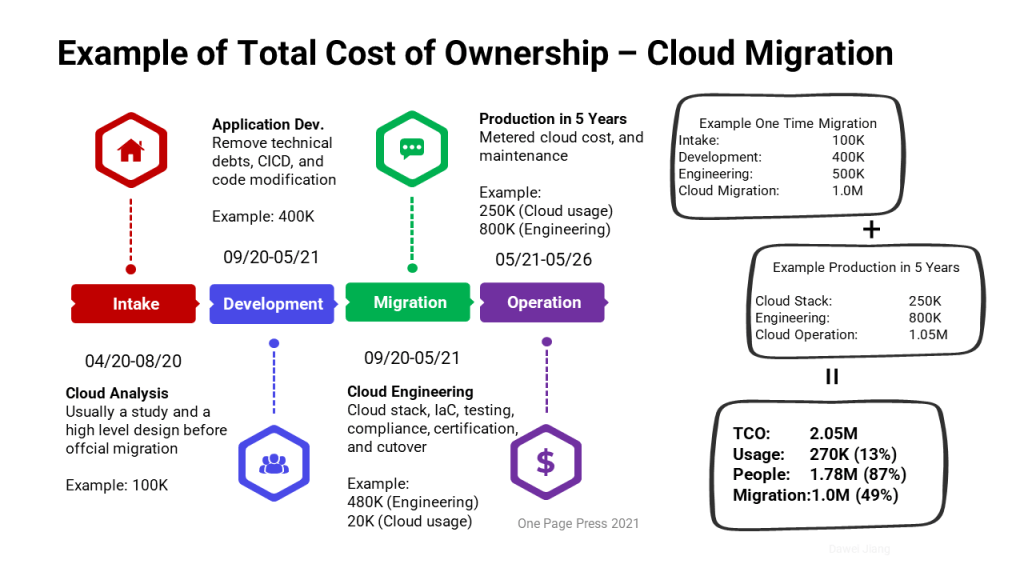
What does the simple example of TCO tells us? People cost is and will continue be your top IT cost. Therefore, besides invest on the tools and technologies, invest on people; when transform technologies, transform the skillsets and the culture first.
I’ve seen examples where a cloud enabled development team build in cloud migration as part of normal development task, and significantly bring down the cost by not having a special migration task force. However, this does not come free and requires early investment, training, and leadership support.
Cost saving, cost clarity, and cost opportunities are among the best offers cloud computing provide. Cloud makes cost saving not only possible, but quantitatively measurable.
 One Page Press