Disaster recovery is a critical part of business continuity. It is a technical implementation to ensure data and services are available in an unfortunate event. This usually requires setting up an alternate processing site either via on premises data centers or via a cloud service provider.
Some key concepts related to disaster recovery are:
- Recover time objective (RTO): how fast to recover from a disaster
- Recover point objective (RPO): to what previous point data will be recovered
- Failover: data processing switch from the main site to the alternate site
- Failback: once main site is normal, switch data processing back
- Parallel: both sites process data simultaneously
- Hot, warm, cold site: how ready the alternate site is set up
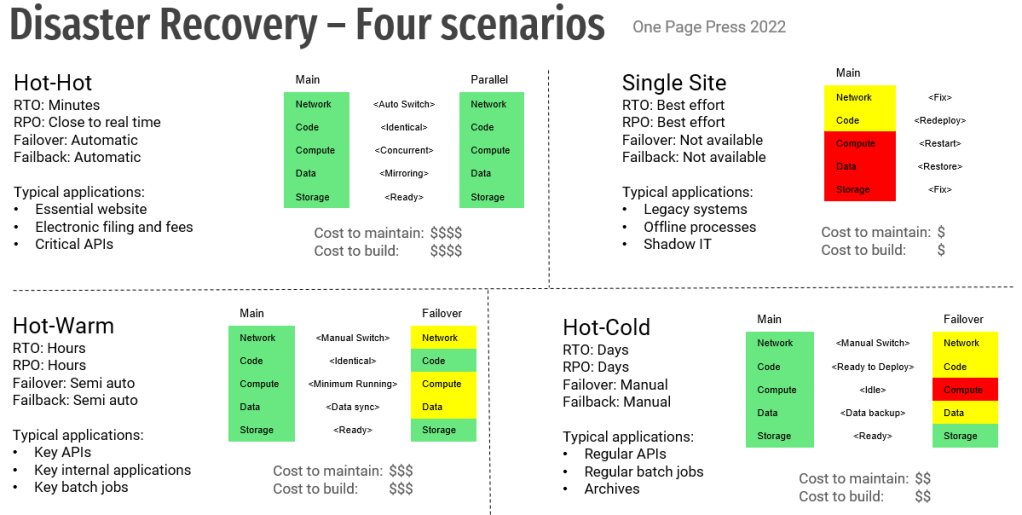
This picture visualizes the options of disaster recovery site and their characters. It shows a T-shirt size estimate of cost to build and cost to maintain for each options, and suggests some applicable applications. It builds a simple view, but can be used to start the early conversation of applicability of each solutions.
And you might see what I implied: eliminate legacies and shadow ITs. They are usually nightmares regarding disaster recovery, and plan ahead.
I hope this helps.
 One Page Press