This follows my two other posts: zero trust architecture and system availability landscape. It further illustrates what protection surface means and what transaction mapping looks like.
Uptime is usually measured with availability and performance. Availability is total time minus down time, indicated by a total percentage point. This is where we use 2 9s (99%), 4 9s (99.99%) and 6 9s (99.9999%) to label our service level agreement. Performance is usually related to latency. indicated by response time of one leg of data flow. In my example here, 10 to 80 is a round trip from a browser request to a browser response with a high coarse grained data flow.
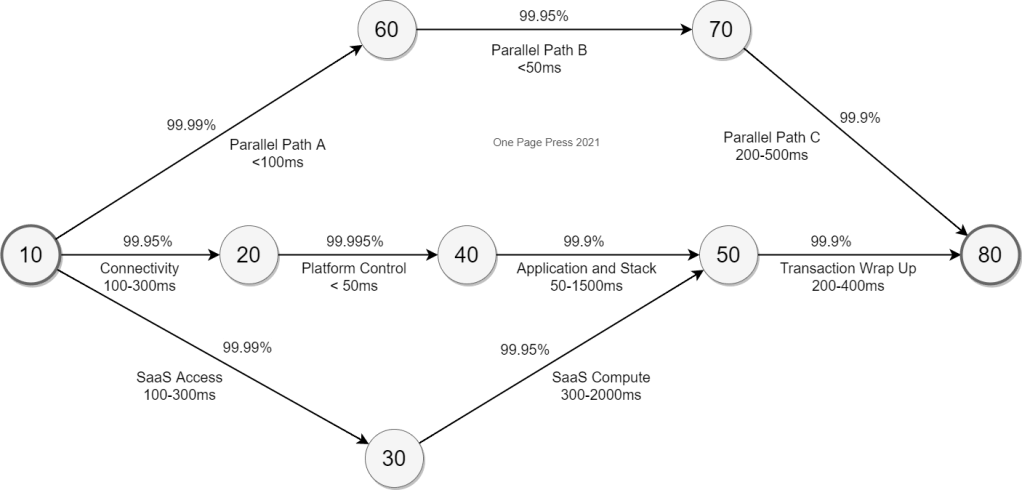
This is a conceptual diagram that more details should be furnished. It is not specific to host environment, technologies, or nature of your application. Please note, a lot of our system transaction requires a “wrap up” portion, either hosted in the same system, or be supported by other interfaces. This is where an external system received update, a notification is sent, some triggers are fired to get cascading update that is essential to consider the entire transaction complete. Those are not necessarily a browser experience or user experience, but essential to the overall flow, as integrity is just as important as confidentiality and availability, the three pillars of FISMA mandate.
SaaS route is an example that your business transaction goes external way. And parallel path can interpreted in a few ways, it could mean your future architecture, a replacement of your existing flow; or it could mean zero trust protection surfaces and its over-shadowing impact. It is end to end, and it could and will add additional impact to both uptime and latency.
I highly recommend a thorough study for all your high value asset systems. It will depicts your weakness, your opportunities, your integration challenges and any impact coming to you with any future change you are contemplating.
And, it also build the right expectation of service level agreement you need with your clients.
 One Page Press